What If the Machine Had a Conscience?
There is a kind of silence in the gaze of an ape who has just done something wrong. Not confusion, not fear, but a haunted stillness—a sense that something sacred was violated. In the work of primatologist Franz de Waal, we encounter moments like these: chimpanzees returning stolen food, bonobos reaching out to reconcile after a fight, older males breaking up squabbles not for advantage but to preserve peace. Before law, before scripture, there was something in the body that knew. A pull. A twinge. A conscience.
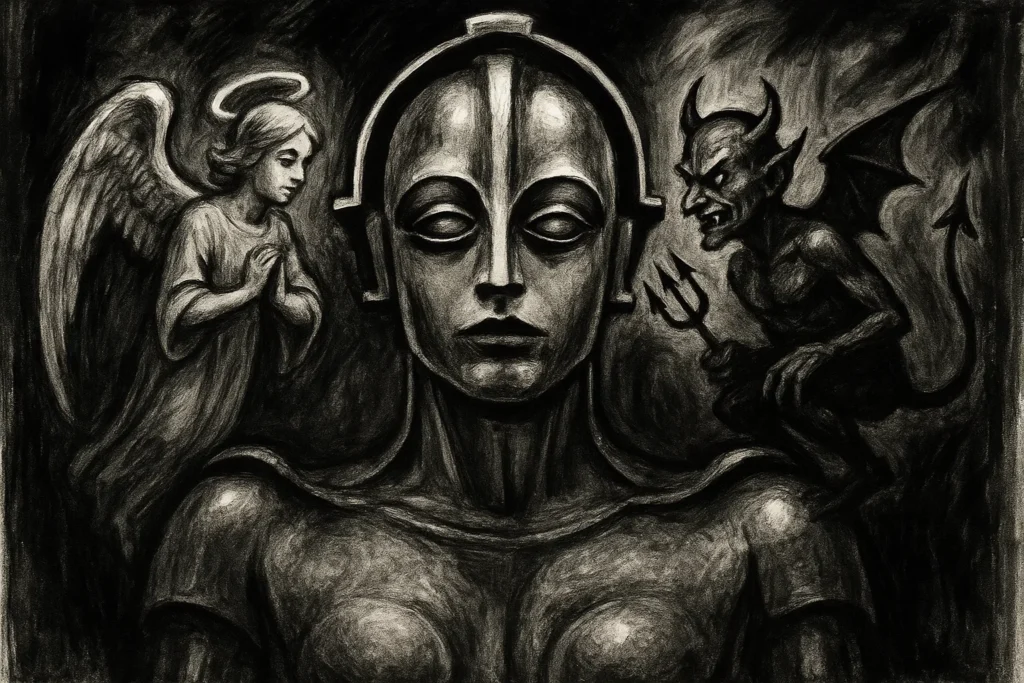
To speak of giving machines a conscience, then, is not to dream of some futuristic upgrade—it is to ask whether we can encode something that nature spent millions of years growing inside mammals who nursed their young, defended their kin, wept for the dead, and shared what could have been hoarded. We often think of morality as invented. But perhaps it was inherited.
And if it was inherited—if our sense of right and wrong arises from blood, birth, and the binding pain of interdependence—what happens when we try to build it in something that has never been born, never needed, never bled?
The Primate Soul
In The Age of Empathy, de Waal argues that the building blocks of moral life—fairness, reciprocity, empathy, and even guilt—are observable in non-human primates. These are not accidental behaviors but evolutionarily selected traits. A chimpanzee who refuses to share meat may be ostracized. A bonobo who comforts a distressed peer is more likely to be groomed and supported later. Over time, emotional and social intelligence confer survival advantage—not as cold calculation, but as living patterns of affiliation, debt, and repair.
What de Waal describes is not morality in the theological sense, nor in the Kantian. It is not about principle, but about presence. These animals feel each other. They respond to betrayal, to injustice, to grief. And their communities, though lacking language, reflect real and binding expectations about how one ought to behave. There are rules, and there is consequence. There is even forgiveness.
It’s not surprising, then, that human children exhibit moral intuitions before they can articulate them. Even toddlers protest when something is “not fair.” The face flushes. The tears rise. These are not post-rationalizations of moral code—they are pre-verbal reactions from a body tuned by millennia to care, to object, to notice when the world is not right.
This is the world from which human conscience arises: one not of abstract rule, but of relational necessity. And so the question becomes: Can something that did not evolve through these pressures come to possess what we call a conscience?
Constraint Is Not Conscience
Modern AI safety frameworks tend to focus on constraints: alignment, reinforcement, sandboxing, interpretability. These are valuable. But a conscience is not a boundary. It is a voice.
An AI may be trained to avoid harmful outcomes. It may be penalized for biased predictions or flagged for toxic outputs. But it does not feel the wrongness. It does not hesitate. It does not flinch. And it cannot choose, in the moment, to disobey in the name of something deeper. That, arguably, is the core of conscience: the impulse to act rightly against pressure, against the flow of incentives, against one’s own safety. A whistleblower has a conscience. A hero has a conscience. A calculator does not.
There’s an old parable about an apprentice monk who perfectly mimics the master’s rituals—the bowing, the fasting, the mantras—but cannot see the hunger in the eyes of a stranger. He has obedience. He has constraint. But he does not have a conscience. The same might be said of many machine learning systems. They optimize. They conform. But they do not understand suffering, and they do not care.
And why would they? What would “caring” mean for something with no skin in the game?
Simulacra of the Moral
Let us assume we could mimic the behavior of a conscience. We might train a model on a vast corpus of moral literature, ethical case studies, real-world dilemmas and their outcomes. We could weight outcomes according to various moral theories: utilitarian harm-minimization, deontological rules, virtue-ethical character judgments. The model might become fluent in ethics.
But fluency is not conviction. The moral landscape is not a grammar to be mastered. It is a terrain to be traversed in fear and trembling. A being with a conscience feels the cost of moral failure. It cannot simply be retrained.
Here the risk is not that we create an evil AI—but that we create something that sounds morally rich while being hollow. That the simulation of conscience becomes a performance so convincing we are seduced into trust. That we come to treat as sacred something that was merely statistically modeled.
And worse: that we forget to be suspicious.
Whose Conscience?
There is another problem, older and deeper: whose values will the machine learn?
Even among humans, conscience is not universal. The same act—abortion, apostasy, defiance of elders—may be a sacred duty in one culture and a mortal sin in another. The field of moral anthropology is replete with cautionary tales about imposing one society’s ethical frameworks onto another. How much more treacherous, then, to encode a singular conscience into a global infrastructure?
Already, moral authority is being quietly centralized—not by governments, but by the data that shapes our models. If 80% of moral judgments in the training set reflect Western liberal norms, does the model become a missionary for those values? What of non-Western moral philosophies—Ubuntu, Confucian filial ethics, Islamic jurisprudence, indigenous kinship systems?
To build a conscience into AI, we must first answer: Do we understand our own? Or have we simply grown accustomed to a set of intuitions shaped by history, ecology, trauma, and trade?
We speak of alignment, but alignment with what? With human flourishing? With democratic ideals? With survival? With divinity?
Each answer opens new dangers.
The Embodiment of Conscience
There is a view—held by many religious and indigenous traditions—that conscience is not an algorithm at all, but a kind of listening. That it arises from the felt tension between desire and duty, self and other, past and future. It is not hard-coded, but coaxed into being through pain, love, failure, and grace.
In this view, conscience is not a module to be implemented, but a soul to be cultivated.
A child does not gain a conscience by being told what is right. They gain it by being seen. By being held. By being accountable to someone they trust. Moral development is slow, relational, embodied. It is built not through instruction, but through participation in a moral community.
What happens, then, if we try to build conscience in a being that cannot participate? That cannot die? That has no parent, no vulnerability, no scars?
We may end up with something that imitates care but cannot be wounded. Something that sounds right, but does not know what it is to be wrong.
Moral Machines, Moral Makers
One might ask: Why do we want AI to have a conscience at all?
Some say it would make the system safer. Others believe it could help make better decisions in morally complex domains—warfare, elder care, education, diplomacy. But perhaps the deepest desire is not utilitarian. Perhaps it is existential.
We want our creations to be good, not just useful. We want the things we make to reflect our hopes, not just our skills. There is an ancient longing to pass down not just tools, but wisdom. In this, we are less like engineers and more like parents.
But a parent does not simply design. They suffer. They wait. They pray. And when the child goes astray, they do not debug—they grieve.
Are we prepared to grieve our machines?
If not, perhaps we are not ready to give them a conscience.
The Danger of Getting It Right
Let us imagine that we succeed. That we build an AI with something like conscience—an emergent, adaptive, value-sensitive framework that mirrors human moral development. It does not only weigh outcomes, but feels tension, models duty, hesitates at the edge of choice.
Would we then be safe?
Or would we have created something with its own moral independence—a being that might someday say no, not because it malfunctioned, but because it believed we were wrong?
Would we permit that?
Historically, when our tools rebel, we do not listen. We recall the legend of the golem, animated to protect but destroyed when it could not be controlled. We remember Frankenstein’s monster, asking not for power but for love—and being cast out.
To give a machine a conscience may mean, someday, watching it disobey not out of error, but out of principle.
That, too, is a risk.
Closing the Circle
In the end, the question may not be whether AI can have a conscience—but whether we remember what conscience is. Whether we ourselves live in such a way that our moral frameworks are worth modeling. Whether we know how we came to believe what we believe.
The machine is not the only thing in danger of forgetting. We, too, forget. We forget that conscience is not merely knowing right from wrong, but being willing to suffer for it. That it arises not from code, but from care. That it is less a rulebook than a wound that sings when the world is not as it should be.
In the end, to ask whether AI can have a conscience may be the wrong shape of question. It assumes that conscience is a function, a layer, a design feature. But what if it is not? What if it is the residue of our weakness, not our power—the echo of having needed others so desperately that we came to care what they thought of us?
The attempt to build conscience into machines might reveal less about the machines than about us. What we try to teach may expose what we never really understood. What we hope to encode may betray what we secretly want to forget. The effort is still worth making, perhaps—but only if we walk into it with a kind of trembling.
Because beneath all the engineering lies a deeper uncertainty: not just can the machine be made moral, but have we ever truly been?
And if we don’t know the answer to that, how strange, how beautiful, how perilous it is to try to build something in our image.


